
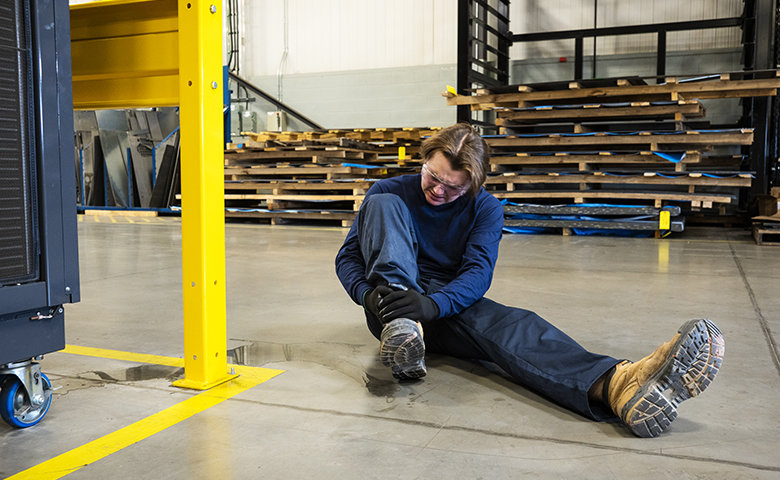
Slips, trips and falls are a perennial issue in the workplace. According to the National Safety Council’s Injury Facts, they’re the third-leading cause of DART (days away from work, job restriction, or transfer) cases. And as a recent article in Safety + Health magazine points out, slips, trips and falls are a stubborn challenge despite being relatively well understood by safety professionals.
In a column titled “Breaking the Cycle of Slips, Trips and Falls,” safety expert Rhonda Piggee Johnson notes that almost every EHS pro cites environmental hazards, housekeeping, and human factors as the three major causes of slips, trips and falls. People slip on floors when they’re wet, when someone leaves a trip hazard in a walkway, and when they’re in a rush or distracted or otherwise aren’t paying attention to what they’re doing. But just because the reasons that people fall are obvious doesn’t mean they’re easy to fix.
These three causes of slips, trips and falls don’t operate in isolation. Rather, they overlap in ways that are both dangerous and often hard to spot. As Piggee Johnson says:
The issue lies in how human factors, environmental conditions, and workplace housekeeping intersect. When a crew finishes their shift and fails to properly tidy their work area and someone from another team hurries through by without paying attention, or when someone tracks in slush from a snowy parking lot and someone else is daydreaming as they cross the now-slick area. There’s no silver bullet that will fix the problem in these examples, because these examples aren’t a single problem at all. Instead, they’re a bundle of issues. One safety concern is exacerbated by another, and suddenly there’s trouble brewing.
To that end, anyone who wants to make strides in reducing slips, trips and falls in the workplace should attempt to deal with all three of these issues simultaneously. Piggee Johnson calls this a “braided approach,” and she suggests that while it takes more effort to wrangle multiple issues at the same time, it can lead to more sustainable reductions in same-level falls.
A good place to start is by elevating housekeeping standards. Conducting Human factors training is another excellent way to cut down on slips, trips and falls. And habit-building is a strong third strand in the braid, as it encourages workers to take practical steps like holding handrails and avoiding safety shortcuts, which can cut down on the risk of slipping and tripping. Even better, human factors initiatives often include elements of habit-building, making them an extra-efficacious way to keep workers on their feet.
As Piggee Johnson notes in her article, there is no magic wand that will make slips, trips and falls disappear. However, she points out that good things happen when companies recognize how human factors interact with housekeeping issues to elevate the risk of incidents. Understanding how entangled these issues are allows these organizations to respond accordingly, and the end result is a safer workplace with fewer slips, trips and falls.