
Always Within Reach:
The Swiss Army Knife Approach to Human Factors Management
The concept of human factors isn’t new. In fact, it’s been cited as a notable issue in the workplace since the 1950s. These days, human factors are widely acknowledged as a common contributor to workplace injuries, playing a role in everything from slips, trips and falls to vehicular collisions. And many continuous improvement practices, like team huddles, the Andon cord, production boards, and Gemba walks, try to identify human factors that are embedded in systems in order to improve the work to be done.
The core concept of human factors is straightforward: a wide range of mental and physical states like rushing, frustration and complacency can affect how people act. If someone is tired or distracted, they’re likely to do things differently than if they’re well-rested and focused on the task at hand. And those variations in behavior can affect the chances of an incident occurring.
Human factors are so ingrained in our daily activities we often fail to recognize them unless they’re brought to our attention with a question, a close call, or a catastrophe. We’re all aware that fatigue can cause us to drag our feet, and that rushing can result in us bulldozing through the day. And it’s just as evident that safety outcomes can be affected by these factors—sometimes only in hindsight. And yet, despite the widespread recognition of human factors as a major safety issue, there is no equally agreed-upon way to deal with them in an EHS context.
With a dizzying array of approaches to human factors management comes a vast range of outcomes. Many common tactics, such as telling people to “just pay more attention,” flat-out don’t work. Because human error is rarely intentional, there’s little value in telling people to avoid making mistakes—because people aren’t trying to make a mistake in the first place. Other approaches, such as using toolbox talks to highlight the dangers of common states like distraction, are relatively ineffective in the long term if they aren’t accompanied by a suite of related interventions
On the other hand, taking a skills-based approach to managing human factors can be incredibly effective. Rather than instructing workers on what to do or not do on any given day, safety professionals can build employees’ personal knowledge, skills and habits. This helps employees get better at recognizing human factors in real time. It helps them know what practical steps they can take to mitigate the risks posed by those factors. And it establishes safety habits that act as a backstop to protect employees in moments when human factors go unchecked.
Crucially, since human factors are ingrained in everything humans do, teaching people about them can provide universal knowledge and skills for every situation they encounter. This human factors know-how travels with workers throughout the worksite. It stays with workers as they get in their car on the drive home. And it keeps them safe off the job, which is where most injuries occur.
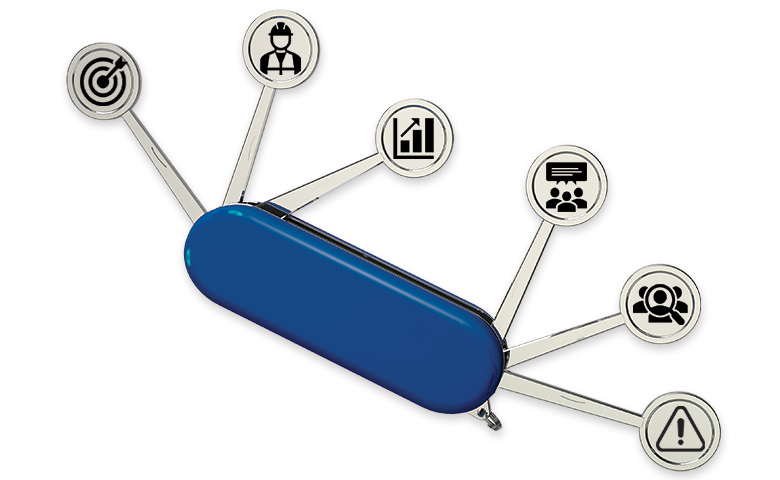
In fact, practical and portable skills are so important that they are considered one of the hallmarks of any strong human factors management plan. Think of it as taking a Swiss Army knife approach to dealing with human factors, by providing workers with a single multi-tool they can take with them to deploy in any context, and in a variety of ways, based on their needs in the moment.
Of course, it’s one thing to understand the value in managing human factors with a Swiss Army knife-style program, and it’s another thing entirely to actually build and implement a versatile program. Everyone knows that human factors are a major safety problem. But sustainably managing human factors requires the entire company all rowing in the same direction. Because even though we know humans are fallible, we can’t blame them for rushing or fatigue. Organizations need to give employees tools to spot these states in real time and then do something about them. Companies also have to adjust human and technical systems to minimize the potential for human factor risks. And there are a handful of barriers that get in the way of that happening.

The first obstacle is the general state of safety at a company. Human factors management is considered an advanced safety issue for a reason. It can be exceedingly hard to mitigate the effects of distraction, frustration and other states if the safety basics aren’t taken care of first. There are no shortcuts in safety, after all, and standard compliance measures must be adequately taken care of before a company can start properly reining in human factors.
Assuming a company has compliance basics in hand, the most common obstacles to human factors management are usually a combination of time, cost and competing priorities. There isn’t a single safety professional with too much time on their hands. Safety departments are often stretched thin, with more to do than time to do it in. And all too frequently it can feel like safety folks have to make the case to secure extra budget they need to implement a new initiative. Whether the most acute pain point is a lack of time, a limited budget or an overly long to-do list, the effect is the same: building and implementing an effective human factors management program can be out of reach.
This is especially true when there’s a lack of in-house expertise. Safety professionals require an exceptional amount of specialized knowledge as it is, and so it’s no surprise that many folks haven’t had the opportunity to develop the deep understanding of human factors that will allow them to create an effective training program. And that lack of expertise can feel like an additional barrier to navigating the early days of implementing a human factors solution.
And since human factors are so common and intuitive, if people aren’t familiar with how hard it is to manage them at a site level, or the risks associated with not managing them, it can be hard to get leadership’s attention and support because it can feel impossible or unnecessary.
Despite all these challenges, many organizations are still making significant efforts to reduce the impact of human factors like stress, fatigue and complacency. But the heart of human factors training is teaching people how to manage “people stuff”. And “people stuff” is hard. So is getting every director and manager and supervisor who is in charge of people on the same page when it comes to implementing a sustainable human factors management program.
All too often, this results in a one-and-done initiative that doesn’t have staying power. Or a program that doesn’t get the education part right. Or, worst of all, a program that looks and feels just fine, except that it misses one critical element: it fails to win workers’ hearts and minds.

For a human factors management program to work, it needs to have a few essential features. There aren’t many must-haves, but you can think of them as the secret sauce of reducing human error and without them, any human factors-related intervention simply won’t have the desired effect.
First among these key elements is employee buy-in. Winning hearts and minds. Helping employees truly believe that human factors training is something they should care about on a personal level. When people think a training program is worth it, they’ll pay more attention, they’ll learn more and they’ll remember more in the coming months and years. And the opposite is also true: if workers think training is a waste of time they’ll tune out from the start and the entire endeavor will fall flat.
95% of deaths suffered by workers
were the result of off-the-job injuries
A simple, flexible framework is a necessary feature for any human factors management program. Fancy theories about human behavior have their place in safety journals, but when it comes to the day-to-day practice of dealing with human factors on the shop floor, you need a conceptual framework that everyone can learn and use.
That framework also has to be flexible enough to be relevant in a whole bunch of different situations. Last year, National Safety Council statistics show that 95% of deaths suffered by workers were the result of off-the-job injuries. And when it comes to injuries, the Council estimates that when you account for both the short-term and long-term consequences of lost time injuries, over 1.3 billion days of work were lost due to incidents that occurred away from the workplace. This means that if a human factors management program only works on the jobsite then it’s not actually managing human factors. Because “people stuff” causes risk everywhere, all the time.

Human factors management programs are significantly different from other safety systems, and human factors training isn’t built with static hazards in mind. Instead, it’s designed to deal with the constantly fluctuating risks of workers’ mental and physical states. After all, the degrees to which employees are fatigued, in a rush, or distracted can ebb and flow from minute to minute and hour to hour. A program that accounts for that fact should look and feel different than other risk-management plans.
Leading human factors management programs like SafeStart are so effective because they feel tangibly different from the get-go. This, in turn, makes it easier to convince workers that the training will be noticeably different than standard compliance efforts.
Workers see the value in it from the start. In SafeStart’s case, they also see the value in it for their families. One of SafeStart’s key differentiators is that in addition to helping people stay safe off the job, it gives them resources to keep their family safe too. As a result, workers are much more likely to pay attention to training, knowing that it could have a tangible impact on their loved ones’ well-being.
These types of human factors management programs are designed according to rigorous adult learning principles. Vendors like SafeStart also provide robust teaching materials and other supports to help bridge any knowledge gaps, which makes it much easier to implement, especially for the majority of organizations that don’t have a human factors expert on staff.
The best human factors management programs focus on developing people’s individual safety awareness and skills. SafeStart additionally educates people about the practical need to recognize human factors in real time, and it teaches workers how to mitigate the effects of rushing, frustration, fatigue and complacency.
Human factors training like SafeStart can also have an outsized impact on establishing a common language among the workforce. Quite simply, SafeStart changes the way people talk by giving them a common understanding and a common language to discuss human factors, errors, and safety habits.
This may seem like a small outcome of human factors training but its impact can be huge. Once a common language takes hold, there is often a noticeable shift in the tenor of communication between individual people, and in the efficacy of communication among teams. Because everyone begins to see human factors in the same way, everyone has the same shorthand to talk about it and everyone has a newfound recognition of the efforts that their coworkers and employer are making to deal with the dangers of human error.
Every department has a KPI they pay attention to more than others. An entire organization cares about culture, but the human resources department really cares about culture. Operations is zeroed in on productivity and wasted material. Safety folks are hyper-focused on injuries and near misses. Finance is attentive to workers compensation and employee turnover, because they feel it when those expenses get out of hand.
Once a company starts managing human factors with a program like SafeStart, the safety department is usually the first to benefit because, for all the reasons mentioned above, there is an almost invariable improvement in safety outcomes. But other departments will also start to take notice too.
There’s a short line between a human factor like distraction and an injury. There’s also a short line between distraction and wasted material. And there’s an equally short line between distraction causing an interpersonal problem that leads to workplace conflict. When a human error happens, there could be all sorts of adverse outcomes, many of which are not related to safety. All of these negative outcomes are the result of human factors getting out of control.
Once a company starts using SafeStart to reduce the likelihood of human error, good things start happening across the board. There are fewer safety incidents. Fewer cultural disruptions. And less damaged equipment or wasted material. All of a sudden, what initially seemed like a safety initiative becomes something the entire organization will benefit from.
Good human factors management skills are portable and versatile, and so are its outcomes. Every single department in a company can reap the rewards of reducing human error.
Any company that is serious about managing human factors needs a program that works for every task that people do in the workplace. Ideally, human factors training should keep people safe when they’re off the job too. And a human factors management framework should be simple enough that anyone can learn it and use it.
A strong human factors management program should feel like a Swiss Army knife. It should provide portable skills. It should work in any situation and be useable by everyone. Many companies are already making an effort to reduce human error, but if their current approach doesn’t feel like it puts a versatile tool in every single employee’s pocket then there’s room for improvement.
Swiss Army knives are precisely engineered but intuitive to use. This is the same premise that underpins SafeStart, a smart, well-built human factors management program that helps workers understand, recognize, and respond to human factors, day in and day out. And a common language and context so everyone can identify system improvements to minimize human factor risks. SafeStart provides lasting value up and down an organization, from safer employees to stronger cultures and better productivity. It’s designed to overcome the many obstacles that traditionally prevent companies from sustainably managing human factors. And the skills that SafeStart teaches are, like an ultimate pocket multi-tool, always within reach.